The View > COP31: saving energy won’t be enough to decarbonise buildings
In Antalya, COP31 set an ambitious course for building energy efficiency. Yet much of the carbon footprint of a new or renovated building is locked in before it is even switched on. Europe already has a tool to measure it and bring it down: the LCBI certification.
By Cécile Dap, LCBI Director
A blind spot in Antalya. The Antalya Pact aims to cut the operational energy intensity of the global building stock by at least 25% by 2035 compared with 2020. This is essential, and the direction deserves welcome. Yet it falls short: as the energy mix decarbonises, construction can account for 50 to 80% of a building’s emissions over 50 years.
A common language for Europe
With the revision of the Energy Performance of Buildings Directive (EPBD), whole-life carbon assessment (LCA) will be mandatory for new buildings: from 2028 for buildings larger than 1,000 m², and from 2030 for all new buildings. In its contribution to the European Commission, LCBI stresses the need for a common method. Without one, even a few methodological differences could mask genuine progress in design and make it impossible to compare progress across Europe. LCBI also calls for fossil and biogenic emissions to be reported separately, ensuring that the carbon stored in bio-based materials receives due recognition.
From Luxembourg to Milan, from Munich to Brussels
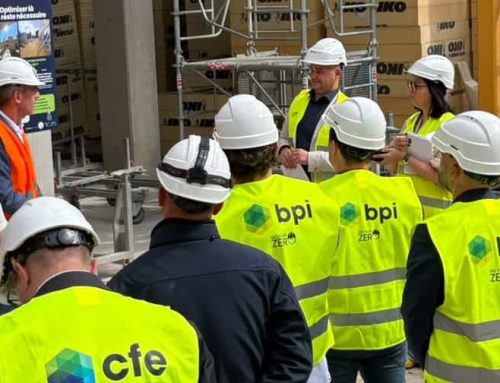
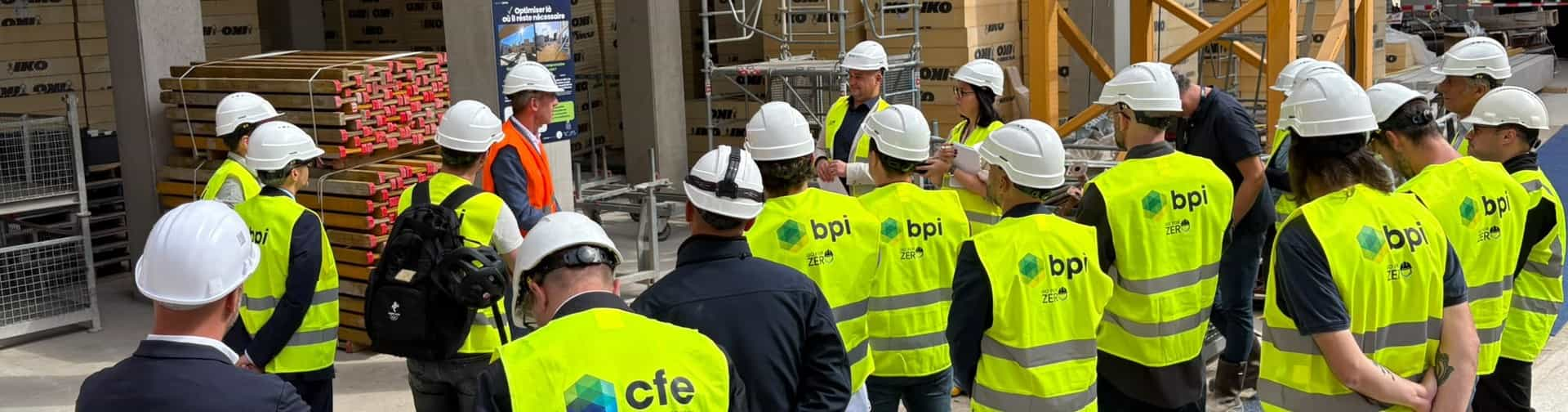
In Luxembourg, in the Kirchberg business district, Kennedy Park achieved the Excellence level at design stage in September 2026. Developed by BPI Real Estate, this office scheme uses a hybrid structure of mass timber and low-carbon concrete to maximise biogenic carbon storage.
In Milan, CityWave, designed by BIG for Generali Real Estate, was certified at Performance level at the same time. This 73,000 m² office scheme stands out for its 1.3 MW solar plant, which covers 65% of its heating and cooling needs.
In Munich, The Stack, a 17,100 m² office building developed by AXA IM Alts, achieved the Excellence level in September 2025. Its hybrid structure uses 1,800 m³ of Austrian spruce, for embodied carbon of 325.5 kgCO2e/m².
In Brussels, Luxia, 13,000 m² of offices developed by AXA IM Alts and designed by DDS+, was certified the same month at Performance level, with a construction footprint of 931 kgCO2e/m² over 50 years and operational emissions of 11.2 kgCO2e/m² per year. The existing AXA office building was partly demolished, restructured and rebuilt to suit new ways of working.
In Esch-Belval, Roots, developed by BPI Real Estate and Unibra Real Estate, is turning a former steelworks site into a mixed-use scheme of more than 20,000 m² combining housing, offices and shops. Certified in October 2024, it was the first project in Europe to reach the Excellence level, with embodied carbon 25% below the threshold and 159 kgCO2e/m² of biogenic carbon stored.
Eleven countries, and only the beginning
With Portugal’s recent opening, the LCBI certification is now in use in eleven European countries. Since September 2026, it has also covered logistics assets. Teams are now working to include renovation—which must also be decarbonised—within its scope, with a dedicated certification set to launch in early 2027. In Spain, the Ecómetro association has chosen to align its approach with the LCBI framework, adopting it as a unified European standard—a strong sign of the harmonisation under way.
A labelled building proves it can be done. A shared framework transforms the European market. Joining LCBI means helping to write that common language.